
Simply put - Yes, wireless power is safe.
At Powercast, our EDGE Platform provides safe wireless power technologies that create continuity and elevate operational boundaries. All wireless power systems must be tested and maintain regulatory compliance just like other wireless devices in your home, such as Wi-Fi routers, TVs, computers, etc. These tests include commonly known things like electromagnetic emissions, but it also tests for safety. Here are some insights into how our technologies operate with safety in mind.
Radio Frequency (RF) Power
RF power uses energy carried by radio waves to deliver power to compatible devices. The energy carried by these waves is comparable to and often less than the energy in waves received and transmitted by the average mobile phone.
In the United States, the Federal Communications Commission (FCC) sets limits for RF-emitting devices and systems to ensure safety. Our RF transmitters, like Wi-Fi routers, must pass (and do pass) all of these tests.
Powercast EDGE RF power products are all FCC-compliant. Our EDGE RF Hubs (PowerSpot®, Powercaster®, etc) are engineered and evaluated to operate only within applicable FCC regulations, ensuring that transmissions never come close to creating unsafe conditions.
Powercast’s RF power systems operate in the unlicensed 915 MHz ISM band, which is used safely every day for industrial, scientific, and medical purposes. Frequency isn’t the only thing controlled for safety, though. Factors such as transmitted power, antenna characteristics, and intended operating conditions are all thoroughly vetted by the FCC.
Magnetic Resonance and SmartInductive™ Power
Magnetic resonance and inductive wireless-power technologies transfer energy through magnetic fields in the near field rather than by continuously radiating power through the surrounding space.
These systems are designed so that power transfer occurs primarily between the transmitter and a compatible receiver. They keep magnetic-field strength within applicable regulatory requirements under intended operating conditions.
For magnetic resonance, the transmitter and receiver are tuned to interact efficiently with one another. Objects that are not part of the intended resonant circuit do not couple to the system in the same way as a compatible receiver. This means that the fields bypass non-resonant objects and do not transfer energy to them.
SmartInductive™ products combine magnetic-induction and magnetic-resonance techniques with additional safety controls. These include Foreign Object Detection (FOD), which can help identify conductive objects (e.g., everyday metal objects such as keys) that could otherwise heat during power transfer. Proximity and system-monitoring functions can also reduce or stop power transmission when an unexpected object enters the active charging area.
These safeguards are designed to reduce potential hazards while allowing the system to deliver power efficiently to the intended device.
Reducing Hazards Associated with Wires and Batteries
Wireless power technology can also provide safety and operational benefits by reducing dependence on wired infrastructure and disposable batteries and thus reducing the hazards associated with their installation and upkeep.
This means, for example, less abrasion, sparks, and surges from repeatedly connecting or disconnecting cables. It means less time spent climbing ladders to replace the batteries in hard-to-reach devices. It means running fewer miles of copper wire to fully power edge systems, creating massive overhead costs and electrical fire hazards. It means less worrying about how to safely and sustainably dispose of batteries, which can become costly public health hazards when handled improperly.
Wireless power can therefore contribute to safer and more maintainable deployments when it is properly engineered for the environment and application. The systems the technologies enable can also enhance safety.
Powering Safer and More Connected Systems at the Edge
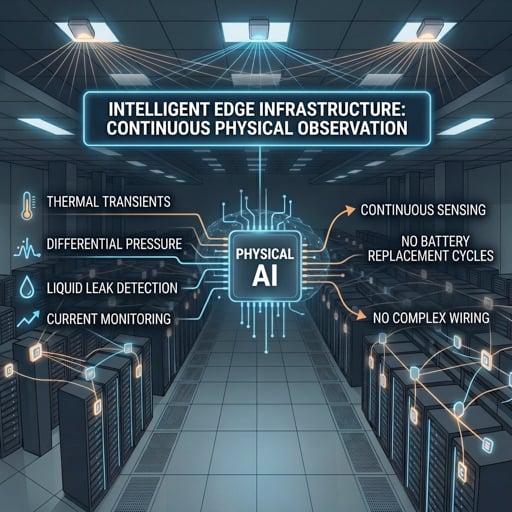
With the continuity of wireless power technology, which doesn't depend on maintenance cycles, sensors and edge devices can operate in higher densities and with greater awareness of the physical world, opening the door for intelligent automated safety protocols.
For example, wirelessly powered sensors can provide real-time information about conditions such as temperature, humidity, pressure, or equipment status at greater temporal resolutions. That information can help identify changing conditions (e.g., sudden exposure of an area to heat or shock) and quicken response time to potential problems.
Likewise, cameras and other edge devices have their own safety applications. In an appropriately designed industrial system, sensor or camera data could be used to proactively initiate protective functions when unsafe conditions are detected. For example, when an edge camera sees a worker getting too close to an active piece of equipment, that visual data can be turned into action, disabling the equipment and preventing an industrial accident.
Ultimately, wireless power is beholden to the same governmental testing and approval processes as technologies that are ubiquitous in everyday life, such as Wi-Fi, mobile networks, etc. Powercast’s technologies are compliant with all applicable FCC requirements, allowing organizations to safely power connected edge devices to create more cohesive, responsive systems without compounding the demands and constraints of maintenance.
-
“RF Safety FAQ.” Federal Communications Commission, www.fcc.gov/engineering-technology/electromagnetic-compatibility-division/radio-frequency-safety/faq/rf-safety.
-
“§ 1.1310 Radiofrequency radiation exposure limits.” eCFR: Title 47 — Telecommunication, updated 29 July 2026, www.ecfr.gov/current/title-47/part-1/section-1.1310.
-1.png)
-1.png)