
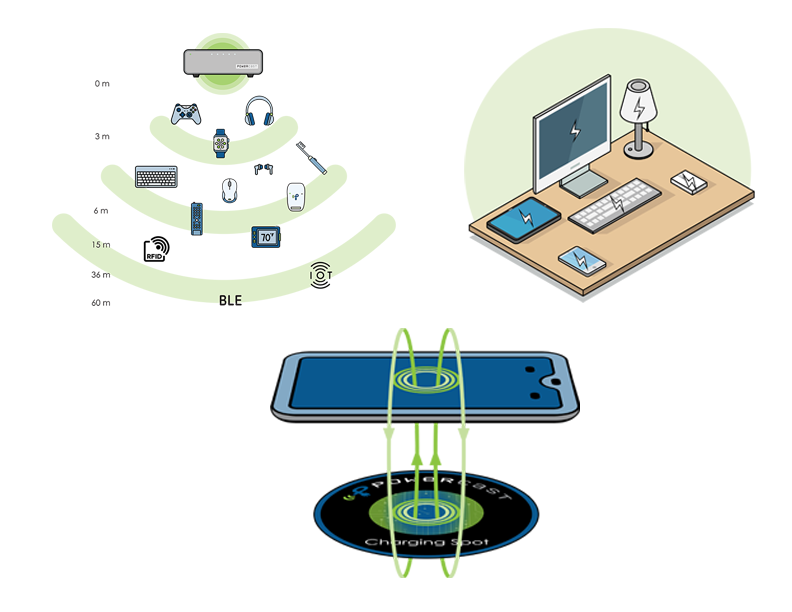
Yes, there are different kinds of wireless power, and the inner workings vary based on the technology involved.
Powercast provides three different approaches to wireless power, each with their own ranges, power levels, and applications: radio frequency (RF) power, magnetic resonance, and the unique SmartInductive™ approach. All three utilize transmitters and generators known as “EDGE Hubs” and receivers known as “EDGE Nodes.” Together, EDGE Hubs and EDGE Nodes form a hardware ecosystem that delivers continuous power wherever it's needed.
Radio Frequency Power: How Does It Work?
For RF power, an EDGE Hub persistently emits radio waves that can be received at distances from 1 to 200 ft. The radio waves can be received by multiple EDGE Nodes, and the amount will depend on orientation and blockages. The energy in these waves is converted into usable direct current power by the Nodes’ Powerharvester® chips and fed to a Node-enabled device. The result is a continuous power zone for all Nodes within range of the Hub.
RF power works similarly to WiFi—invisible and always available—but instead of decoding radio waves for information, Nodes harvest them for power. RF power is ideal for low-energy (up to hundreds of milliwatts) IoT devices that need to operate from longer distances at scale, such as tags, sensors, and smart home hardware that use the power to log, process, and transmit environmental data and tracking information from the edge. RF power is the greener, lower-maintenance alternative to the disposable batteries these devices would otherwise use.
Magnetic Resonance Wireless Power: How Does It Work?
For magnetic resonance, a Hub generates a localized, three-dimensional magnetic field, which acts as a persistent, shared energy zone for Nodes that are tuned to the field’s frequency. Nodes capture this energy from anywhere within the field and convert it into usable direct current to power and/or charge devices, delivering up to 100W to be used by multiple nodes within the zone and allowing for freedom of placement. Typical zone sizes are about desktop size, but can be smaller or larger depending on the application.
Magnetic resonance technology, true to its name, relies on harmony between the Hub and its Nodes. In the way instruments create sympathetic vibrations in other instruments for richer sounds, Hubs create sympathetic vibrations in Nodes for stronger power. Magnetic resonance is best for mid-range solutions and enables functional, cable-free workspaces. It can power and/or charge the laptop, monitor, keyboard, and mouse on a desktop or the various power tools on a workbench.
SmartInductive™ Wireless Power: How Does It Work?
The unique SmartInductive™ approach uses magnetic induction, wherein a transmitter coil generates a concentrated magnetic field that provides energy to a receiver coil, and combines it with magnetic resonance. The Node is dynamically tuned to match the Hub’s frequency, creating a highly efficient two-way system with more flexibility and power generation than magnetic induction alone.
SmartInductive™ alleviates one of the main problems with traditional magnetic induction: regardless of the receiver’s position, the transmitter's useful magnetic field is confined to the area directly above and around the coil. With even minimal distance or misalignment, the magnetic coupling between the two coils weakens, and efficiency drops significantly.
Resonance smartens this rigid system by having the Node communicate with the Hub using advanced signalling, turning the solo into a duet. The Hub and the Node work in harmony, allowing for greater power scaling and spatial freedom, which is crucial for larger devices and devices that dock themselves. SmartInductive™ is best suited for delivering high levels of power (up to 600W) at close range, such as charging telecom equipment, fully autonomous robots, and medical devices.
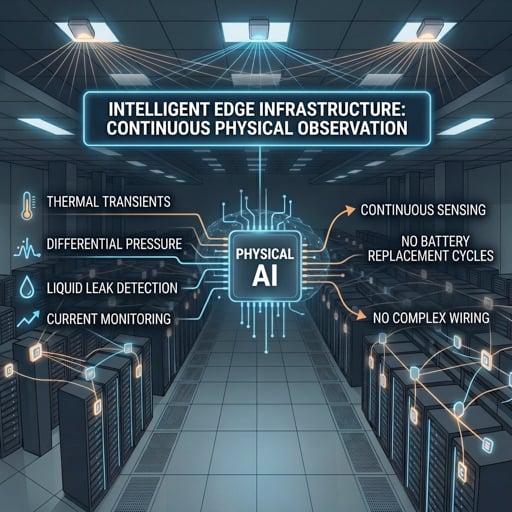
Reliable Power Engineered for Artificial Intelligence at the Edge
All of Powercast’s products are FCC-compliant and ready for deployment in a wide variety of environments. Wireless power is flexible, functional, and the ideal candidate for power infrastructure in the era of AI-enabled robotics and edge hardware.
The technology is already being used, so the question is no longer “Does it work?” It is: “When should I invest in it?” Artificial intelligence is evolving and revolutionizing IoT devices with lightning speed, and you need a power system that can keep up. The answer is now.
-1.png)