Three infrastructures define the modern economy: water, electricity, and connectivity. Each removed a specific scarcity, and each made possible a class of systems that could not have existed before it. Persistent power at the edge is the fourth — and the historical pattern of when it arrives, who builds it, and who captures the value is more consistent than most people expect.
The pattern, and why it is not just an analogy
There is a lazy version of this argument, and it is worth separating out before making the real one.
The lazy version says: important things have been called utilities before, our thing is important, therefore our thing is a utility. That is marketing, and it proves nothing.
The real version is a claim about structure. A defining infrastructure has three properties:
- It removes a scarcity that had been treated as a permanent design constraint.
- Once present, higher-order systems are redesigned around the assumption of its availability — not merely improved, but reconceived.
- The prior constraint becomes historical rather than binding, and people stop designing around it entirely.
By that test, most technologies are not utilities. Better steam engines were not a utility. Faster modems were not a utility. What distinguishes the genuine cases is that the design vocabulary changed — engineers stopped asking a question they had always asked.
Three cases pass the test. A fourth is in progress.
Electrification: the second utility
Before distributed electric power, industrial energy was local and mechanical. Factories ran on steam engines or water wheels transmitting power through line shafts, belts, and pulleys from a central prime mover. The energy architecture dictated building layout — machinery clustered near the shaft, multi-story buildings organized around vertical power transmission, and factory geometry determined by mechanical reach rather than by process flow.
What changed was not engine efficiency. It was the conversion of energy delivery into a distributed service.
The consequences took decades and were structural. Factories reorganized around distributed electric motors, which meant machinery could go where the process wanted it. Buildings went horizontal. Lighting extended productive hours. Urban density rose because energy was no longer capped by on-site generation.
The historical record on this is unusually clear: the productivity gains associated with electrification did not arrive with the technology. They arrived a generation later, when a cohort of managers who had never designed around line shafts reorganized production around the assumption of electricity. The infrastructure came first; the redesign of everything above it came second; the returns came with the redesign.
That lag is the most important feature of the pattern, and it recurs.
Connectivity: the third utility
Information movement had been constrained by physical transport, limited circuits, high cost, and latency. Coordination across distances was expensive. Computation was local. Markets and supply chains ran on delayed information, and organizations were structured around that delay — regional autonomy, buffer inventory, and hierarchy existed partly as a response to the cost of knowing things quickly.
As connectivity became a utility service, those constraints were released. Global supply chains, digital platforms, cloud computing, and real-time financial systems became feasible — not because they were newly imaginable, but because the layer they assumed finally existed.
Again the lag appears. Broadband did not produce cloud computing on arrival. It produced roughly a decade of applications that treated the network as a faster version of what came before, and then a generation of systems designed on the assumption of ubiquitous connectivity, which looked nothing like their predecessors.
The compressed version: fiber, Wi-Fi, cloud
The utility pattern also runs on a shorter cycle, and the recent cases are useful precisely because most readers watched them happen.
Fiber went from scarce, metered, expensive bandwidth to assumed capacity. The applications that defined the following decade — streaming video, real-time collaboration, distributed teams — were not viable under the prior regime and were not really predicted under it either. The build-out preceded the applications, and it looked overbuilt right up until it looked prescient.
Wi-Fi removed the assumption that a device’s location was determined by where a cable terminated. The immediate effect was convenience. The structural effect was the mobile computing era, which required not just wireless connectivity but wireless connectivity being assumed present.
Cloud converted computing capacity from an owned asset requiring capacity planning into an on-demand service. Early framing was cost reduction — cheaper than owning servers. The actual consequence was that entire business models became viable because starting no longer required capital.
Each of these follows the same S-curve: a period where the layer is a niche alternative to the incumbent approach, a steep adoption phase once the economics cross over, and a final phase where the layer is assumed and its absence is what requires explanation.
Notice what is consistent across all three: the initial framing was always “cheaper than the old way,” and the actual value always turned out to be “makes new things possible.” Organizations that bought on the cost argument alone consistently underestimated the opportunity.
The new scarcity
Which brings us to what is currently scarce.
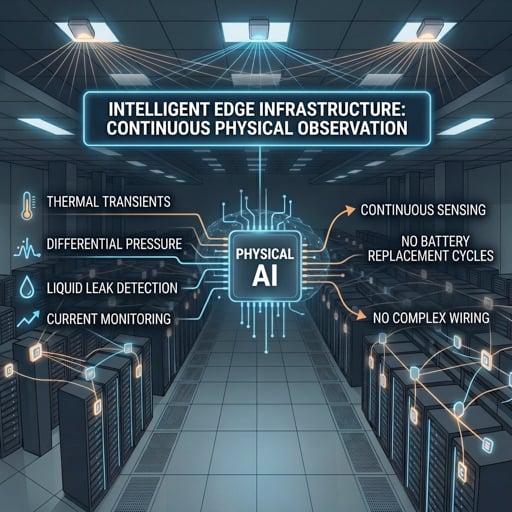
Digital intelligence has advanced extraordinarily. Physical observation has not. Systems intended to perceive and act inside factories, logistics networks, data centers, and infrastructure require continuous, dense observation of the physical world — and they receive periodic snapshots instead.
Sensors are not the bottleneck. IoT Analytics projects 39 billion connected IoT devices by 2030, growing 13.2% annually. Hardware is cheap enough that dense deployment is economically rational on paper.
The bottleneck is the power architecture beneath the sensors. Batteries impose duty cycles by design; devices sleep through most of their operational life so that replacement intervals stay tolerable. Wiring solves continuity but imposes installation cost and density limits that become prohibitive as endpoint counts rise into the thousands within a single facility.
The consequence is a structural ceiling. Models built for continuous reasoning receive discontinuous, low-resolution input. This is precisely the class of constraint that electrification and connectivity previously removed: a scarcity imposed by the architecture of the underlying layer, not by the cost or capability of the endpoints.
Why this qualifies
Apply the three-part test.
Does it remove a scarcity treated as a permanent constraint? Yes. “Sensors need batteries, batteries need replacing, therefore observation is periodic” is currently treated as a fact about the world rather than as a consequence of an architectural choice. That is exactly how line shafts and metered bandwidth were treated.
Are higher-order systems redesigned around its availability? This is the test in progress, and it is where the evidence is genuinely partial. But the direction is visible: closed-loop physical control, digital twins fed by measured rather than modeled state, and agentic systems acting on live physical conditions all become credible only when observation is continuous. None of them are viable on fifteen-minute data.
Does the prior constraint become historical? Not yet. This is what “early on the S-curve” means.
The honest position is that the fourth utility is at the stage fiber occupied around 1998 or cloud around 2007 — the economics have crossed over for specific high-value cases, the general case is arriving, and the assumption that it will be present has not yet propagated into how systems are designed.
The investment logic
For anyone allocating capital, the pattern has a consistent and slightly uncomfortable implication.
The returns concentrate in the layer, and they accrue to whoever builds it rather than to whoever waits for it to commoditize. This was true of fiber routes, of cloud capacity, and of the physical plant beneath every prior utility. The reason is structural: infrastructure layers exhibit increasing returns — coverage engineered once serves an expanding endpoint population, reference architectures make each subsequent deployment cheaper, and the marginal cost of the ten-thousandth node approaches the cost of the node itself.
That is platform economics rather than product economics, and it produces a specific asymmetry for operators too.
An organization that installs the layer converts a compounding operating expense into staged capital, and simultaneously acquires an observation capability its competitors cannot match without the same investment. An organization that waits pays the operating expense continuously and, more importantly, accumulates a data deficit that cannot be retroactively closed. Three years of fifteen-minute observation is not convertible into three years of ten-second observation later. The models trained on the denser data are simply better, permanently.
This is the part that the cost-reduction framing misses, and it is the part that mattered most in every prior case.
Where we actually are
Two claims are worth stating without overreach.
The first is that the timing argument is real but not urgent-in-a-quarter. Infrastructure transitions take years, and the organizations that captured value in prior cycles were early rather than first — they moved when the economics crossed over for their specific use case, not when the category was announced.
The second is that the crossover point is application-specific and calculable. For a data hall at 27 kW racks with coolant in the room, it has arrived. For a warehouse tracking pallets at fifteen-minute granularity where nothing downstream consumes faster data, it has not. Anyone who tells you the crossover is universal is selling something.
What is not in question is the direction. Every prior utility followed the same arc: dismissed as unnecessary, adopted as a cost measure, and eventually assumed so completely that its absence became the thing requiring justification.
Persistent power at the edge is somewhere in the middle of that arc. The interesting question is not whether it completes — it is what you would build if you assumed it were already there.
Powercast’s EDGE platform delivers persistent wireless power at the edge—RF, magnetic resonance, SmartInductive™, and long-life solutions—so devices don’t depend on wiring or constant battery replacement. Placement becomes a design choice, not a power problem.
Frequently asked questions
Isn’t calling this a “utility” overstating it? It is a structural claim, not a rhetorical one, and it can be tested: does it remove a scarcity previously treated as permanent, do systems above it get redesigned around its availability, and does the old constraint become historical? The first is clearly met. The second is in progress. The third is not yet, which is what places this early on the curve rather than at its end.
How long do these transitions usually take? Longer than proponents claim and shorter than skeptics expect. Electrification’s productivity gains took roughly a generation to materialize because they required organizational redesign, not just installation. Fiber, Wi-Fi, and cloud each ran roughly ten to fifteen years from viable to assumed.
Why do returns concentrate in the infrastructure layer? Increasing returns. Coverage engineered once serves an expanding endpoint population, reference architectures reduce the cost of each subsequent deployment, and marginal cost per additional endpoint falls toward the endpoint’s own cost. That is platform economics rather than product economics.
What is the risk of moving early? The usual infrastructure risks: capital committed before the application base matures, and technology choices made before standards settle. These are real. They are weighed against a cost that is paid continuously by waiting — recurring maintenance spend, and an observation deficit that cannot be retroactively acquired.
How do I know if the crossover has arrived for my use case? Compare annual maintenance spend at your current cadence against annual maintenance spend at the cadence your application actually requires. If those two numbers are close, you are not yet at crossover. If the second is several times the first, the constraint is already binding and you are simply paying for it in reduced capability rather than in budget.
Sources
- IoT Analytics — State of IoT 2025: Number of connected IoT devices
- NVIDIA — NVIDIA and Global Robotics Leaders Take Physical AI to the Real World
- International Energy Agency — Energy and AI